
September 12, 2251
Captain Xavier Hauer stood on the observation deck of the Resolute Dawn and watched the battle unfold above Deep Voice.
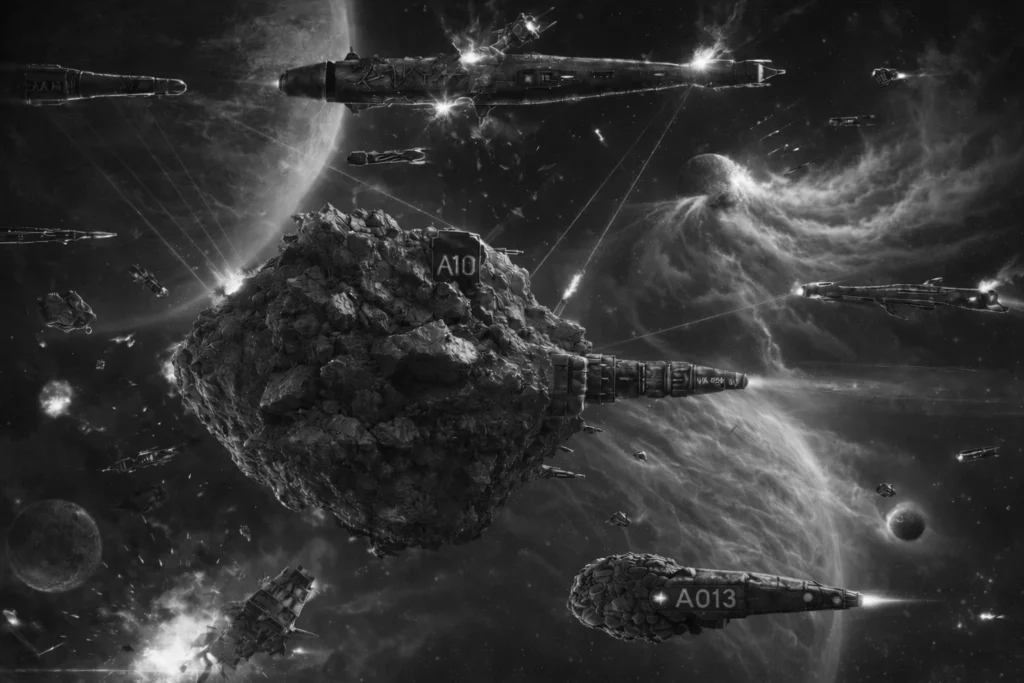
Officially designated 2098 OQ-781, the small planetoid hung beneath the fleet like a pale silver-blue jewel suspended in darkness. Human miners had given it its nickname nearly eighty years earlier after discovering that the atmosphere lowered the pitch of every voice that spoke within it. New arrivals often laughed the first time they heard themselves speak.
The laughter never lasted long.
Deep Voice was one of the strangest worlds humanity had ever found.
Located deep within the Oort Cloud, far beyond the traditional boundaries of the Solar System, it should have been a frozen dead rock. Instead, oceans shimmered beneath an atmosphere composed primarily of nitrogen and sulfur hexafluoride, with enough oxygen to support human life.
A small inner moon orbited so closely that its tidal forces continuously flexed the crust, heating the interior and driving volcanic and geothermal activity. Earthquakes were common. Entire mountain ranges slowly rose and collapsed over centuries.
A second moon skimmed the upper atmosphere.
The moons stirred the atmosphere constantly, preventing the dense sulfur hexafluoride from settling permanently into the lowlands where it could displace oxygen and create invisible death traps. Even so, miners still carried oxygen alarms whenever they ventured into deep valleys.
The system should not have existed. Nothing about it made scientific sense, and yet it was real.
The first explorers arrived in 2173. The first inscriptions were discovered shortly afterward.
The symbols appeared everywhere.
- On the moons.
- On abandoned mining stations.
- On buried structures.
- On navigation markers.
On machines whose purpose remained unknown.
The civilization responsible became known as the Rathas.
The name endured for decades. By 2188, linguists finally achieved a partial translation of the ancient script. They learned enough to understand fragments of history but not enough to understand purpose. That mystery remained unsolved. The greatest mystery of all floated above Deep Voice at that very moment. The Rathas had returned. Or perhaps they had never left.
A warning light flashed across the tactical display.
“Enemy formation closing,” Lieutenant Navarro reported.
The captain nodded.
The enemy fleet advanced through the debris field with relentless precision. Hundreds of black ships surrounded the mining convoy. At the center drifted the massive cargo asteroid A10. Its holds contained the most valuable material humanity had ever discovered. The radioactive crystalline fuel could power advanced nuclear ion drives for decades. Entire economies depended upon it. Entire colonies had been built around it. And for generations, the Rathas had fought to control it.
The first attacks had been small.
- A missing survey ship.
- A destroyed mining outpost.
- A vanished transport.
Then entire convoys disappeared.
The attacks continued for decades.
Every attempt at communication failed.
- No warnings.
- No demands.
- No negotiations.
- Only destruction.
Humanity eventually concluded there was only one solution.
Fight.
“All ships report ready,” Navarro said.
Hauer studied the approaching formation. The Rathas had always possessed superior numbers. They had never possessed superior strategy. Over decades of conflict, humanity had learned an important lesson. The Rathas adapted slowly, and sometimes not at all. They repeated successful tactics endlessly. They expected opponents to behave predictably. Today they had made the same mistake. They had underestimated humans.
“Execute Hammerfall.”
The order raced across the fleet. Hundreds of concealed strike craft erupted from cargo containers, mining equipment, and disguised transport vessels. The Rathas drove directly into the trap. The darkness exploded with fire. Railgun projectiles crossed thousands of kilometers. Nuclear-pumped lasers lanced through enemy formations. Missiles blossomed into brilliant spheres of white plasma. The light of the battle overpowered the light of the stars.
One by one, Rathan vessels shattered. Yet they never retreated. Not a single ship attempted escape. Not one altered course. Even crippled vessels continued advancing toward their targets. Hours passed. The slaughter continued. By midnight, the outcome was no longer in doubt. By dawn, the final Rathas vessel died in orbit above Deep Voice. No ships escaped. No ships surrendered. The Rathas were destroyed.
For the first time in nearly a century, the Oort Frontier fell silent. Humanity celebrated. The celebration lasted less than a year. The investigations changed everything. Thousands of scientists examined the wreckage. What they found made no sense:
- No crew compartments existed.
- No life-support systems.
- No food storage.
- No medical facilities.
- No biological residue.
- No evidence that any living creature had ever occupied any Rathan vessel.
- Every ship was autonomous.
- Every station was autonomous.
- Every mining facility was autonomous.
The entire war had been fought against machines. Further analysis produced even more unsettling conclusions. The oldest recovered components were thousands of years older than the newest. For millennia, the fleet had been rebuilding, repairing, and expanding itself. The implications were staggering. If the fleet required thousands of years to reach the Solar System, then the civilization that launched it originated from another star. At those travel times, any response to its destruction would require millennia to arrive. Assuming anyone remained to send one.
That question became the subject of endless debate.
- Were the Rathas still alive?
- Had they forgotten this expedition long ago?
- Had their civilization collapsed?
- Had they transcended into something else entirely?
- Or had humanity just destroyed the final remnants of a species that vanished before the first Egyptian pyramid was ever built?
No answer was ever found. The mystery deepened around Deep Voice itself. The atmosphere remained impossible to explain. The radioactive fuel required neither sulfur hexafluoride nor oxygen. The mining process required neither sulfur hexafluoride nor oxygen. No known geological process could create the atmosphere in such quantities. The sulfur hexafluoride appeared deliberate, engineered, and purposeful. Yet nobody could explain why. Perhaps the Rathas had known. Perhaps they had forgotten as well.
Years later, Captain Xavier Hauer returned to Deep Voice. Standing beneath the silver-blue sky, he listened to the distant rumble of geothermal storms and watched auroras dancing fifteen degrees away from the magnetic poles. The atmosphere made his voice deeper than it had any right to be. The effect still felt unnatural. Around him stood thriving human settlements built atop mysteries older than recorded history. The war was over, and the Rathas were gone.
Yet Hauer could not shake a single thought. Somewhere beyond the darkness between the stars, perhaps thousands of years away, there might still exist a civilization that once called itself Rathas. A civilization that launched a fleet toward Sol and never learned what became of it. And if they ever came looking for answers, humanity would have a very long time to prepare, or a very long time to wonder.
Either way, Deep Voice would keep its secrets a little longer.