
On Dec. 28, 2011, my great-uncle Chuck wrote me a letter about his slide rule after I had asked him if I could have it. He was delighted.
At the time, I understood that the slide rule was important to him, but I do not think I fully understood why. It was not just an old calculating tool. It was a symbol of an engineering life, of disciplined thought, of a time when technical people solved serious problems with mathematics, judgment and instruments that required skill.
Chuck was a World War II veteran, worked on the Manhattan Project and later had a long career as an electrical engineer, including 25 years at Hughes Aircraft. He earned a Ph.D. and lived the kind of intellectual life that shaped how he saw the world.
When I was a kid, Chuck let me take apart old radios. That may sound small, but it mattered. He was not simply keeping me busy. He was giving me permission to open things, inspect them, wonder about them and understand that complicated systems were not magic. They were built by people. They could be studied.
I did not become an engineer, but I was drawn to technical and disciplined academic environments. I attended an engineering-oriented university as an undergraduate and later earned two master’s degrees, including one from a highly technical university and another from a military institute.
I think Chuck appreciated that. He had a Ph.D. and lived the kind of intellectual life that shaped how he saw the world. When I asked if I could have his slide rule, he was delighted. I believe he understood that I valued not only the instrument, but also the curiosity, discipline and seriousness it represented.
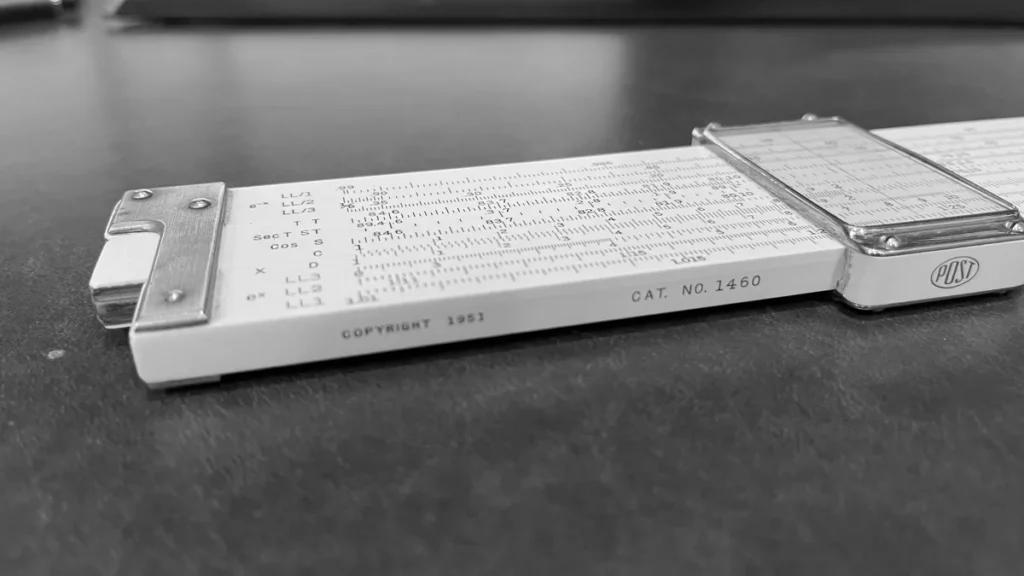
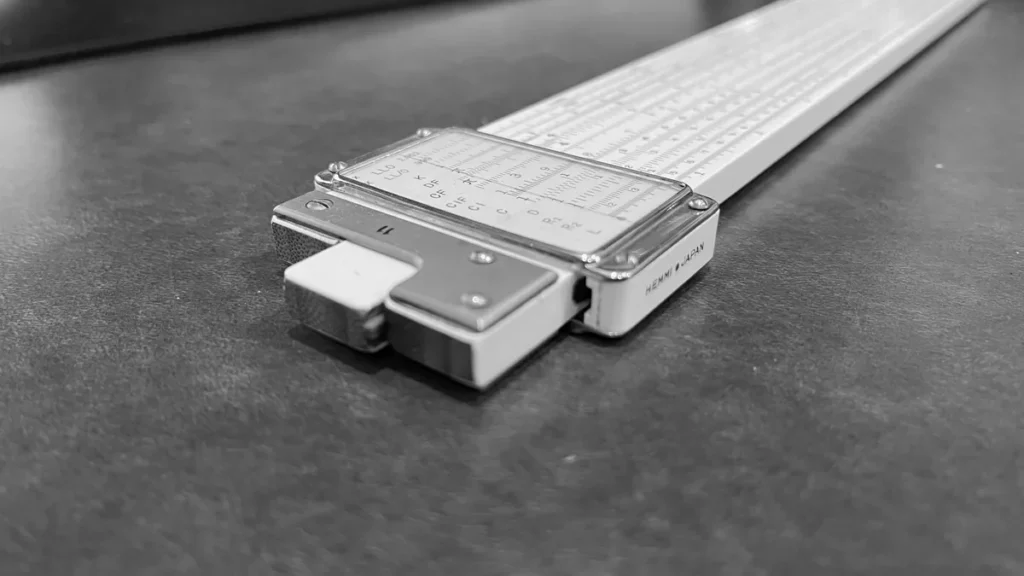
The slide rule I have is a Versalog 1460 from 1951. Chuck had originally received a slide rule from his father when he entered college in 1941, then later traded it for a newer government-issued rule while working. The one I have represents that later chapter. It is also connected to a period when engineers, physicists and communications specialists did real work with tools that demanded fluency, estimation and a feel for numbers.
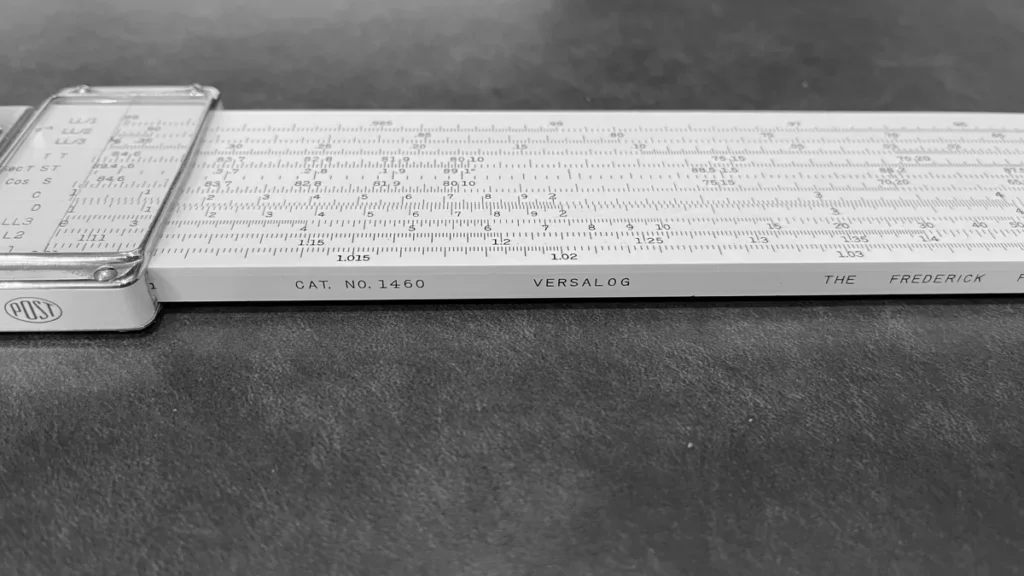
Today, a phone can calculate more in seconds than generations of engineers could have imagined. But a slide rule teaches something different. It teaches scale, proportion, approximation and humility. It reminds you that the answer is not enough. You have to understand the problem.
The Slide Rule Letter
Below is Chuck’s letter, exactly as he wrote it.
The Slide Rule
In my day, the slide rule was the universal hallmark of the engineer. I was no exception. My father bought my slide rule for me when I entered St. Ambrose College as a freshman in 1941. That is he bought me a slide rule, similar to the one I still have in my study, but not quite the same one. But I’m getting ahead of my story. It was known as a “Log-Log Duplex Decitrig Vector”, a mysterious mouthful that requires some little explanation. A slide rule in its most basic form has two scales, marked off in lengths proportional to the logarithm of the numbers on the scale. As everyone who has had high school algebra knows, you can multiply two numbers by looking up their logarithms, adding them, and then looking up the antilog to give the answer.
Well, a slide rule is just a simple tool for adding logarithms. You find the first number on a scale (remember that its location on the scale is proportional to its logarithm) and slide the beginning of the second scale until it is opposite that number. Then go down the length of the second scale until you reach the second number. Opposite it, on the first scale, you read the number whose logarithm is the sum of the two logarithms, or in other words the product you wanted.
Now for the explanation of the slide rule’s title. The “Log-Log” part of that mysterious designation just means “logarithms of logarithms”. There are scales marked off in a doubly logarithmic way, which means you can now multiply a logarithm by any number. Students of algebra will remember that this is equivalent to raising a number to a power. If I multiply a number by itself, I am squaring it, or raising it to the second power. If I multiply it by itself a third time, I am cubing it, or raising it to the power of three. But with a log-log slide rule, I don’t have to be restricted to integer powers like 2 or 3 or 27. I can just as easily raise 7.03 to the 2.45 power, or to the -4.63 power. There are applications where this is a very valuable feature.
The “Duplex” part of the description is not so esoteric. It just means that there are so many scales on the slide rule that you have to use both sides of it. In theory, you can work from a scale on one side to one on the other, but I always had to be careful about that, because the indices (beginnings) of the scales on the two sides were not precisely opposite. Also, the hairlines on the two sides of the cursor were not quite in alignment. So I always had to apply a little Kentucky windage when the problem required me to hop from one side to the other.
“Decitrig” This was the first choice among options I had to make. I was told that whereas Civil engineers measured angles in degrees, minutes and seconds, Electrical engineers (which is what I wanted to be) measured angles in degrees and decimal fractions thereof. That is what the Decitrig option provides. Its trigonometric function scales (sine, cosine and tangent) are duly marked off in degrees and decimal fractions thereof to satisfy the electrical engineers.
“Vector” was another option. This means it has scales of hyperbolic sines and tangents, which are useful in solving transmission line problems. Since I planned on becoming an electrical engineer, that option was of course a must. Unfortunately, I never did learn to use those hyperbolic scales. Years later, when I actually had occasion to solve transmission line problems, it was more natural for me to use exponentials. The hyperbolic functions are just sums of exponentials anyway. As I recall, in order to get the option with hyperbolic function scales I had to sacrifice the “K” scale, which enables one to calculate cubes and cube roots. But one can do that with the log-log scales, so the K scale would be redundant on a log-log rule.
Then there was the case. It came in a black cardboard case, but for just a few dollars extra you could get a neat leather case, bright orange, and for only a few cents more, you could add a little strap which enabled you to hook the case to your belt, so when you walked around everyone could see that you were an ENGINEER! Cool! I don’t remember whether we used the word “cool” then in that context, but whatever word we used, that was the intent.
I only had criticism of that case once. A friend looked at it and said, “Why do you need that? You’re not in the field.” I realized in an instant that he was right. The case is for Civil engineers, who are out on a construction site or surveying in the woods. It is bright orange in color so that if you lay it down in the weeds and forget it, you can spot it again. Today, they would make that bright orange a Day-Glo fluorescent color, but Day-Glo had not been invented then. I passed off my friend’s observation as a case of sour grapes, and continued to carry that slide rule in its bright orange case cool-ly on my belt.
Some time during my stay at the Naval Ordnance Test Station, China Lake the management announced that the stockroom would carry slide rules, and that anyone in the technical fields could check one out, for use as long as they were employed there. I didn’t bite at first, but a friend did, and after examining his rule, decided I would like one too. The Government Issue rules were also “Log-Log Duplex Decitrig Vectors”, but somewhat newer models. I don’t exactly recall the difference, but it seems to me that the newer ones had more log-log scales, which increased the range of numbers over which you could work. They came in a black cardboard case, but that was okay, since I had a desk job anyway.
I used that GI rule for several years, preferring it to the old one my father had bought me. But when the time came for me to leave China Lake, I was faced with a dilemma. I would have to turn in one of the rules to the stockroom, and I knew they wouldn’t bother to check serial numbers. Should I keep the new rule that I had grown used to, or should I keep the old one, which was certainly adequate, for sentimental reasons? Practicality won over sentiment, so I turned in the old one I had had since my freshman year, and kept the GI one.
I also kept the orange leather case, except that the GI rule didn’t quite fit it. The new rule was just a bit wider than the old one, and the case had a taper to it such that the new rule did not go quite all the way in, but protruded by about a quarter inch so the cover couldn’t be closed. But that was all right, too, because the cover had gotten somewhat tattered over the years, and eventually fell off.
I carried that slide rule around through a variety of engineering jobs, using it extensively until I got a pocket calculator, and was later supplied with a personal computer by my employer. Then it stayed in its topless orange leather case, still with the belt strap, in my desk in case I needed it. And sometimes I did. Before I got my computer, I would sometimes forget the pocket calculator and have to haul out the old slide rule, which could not give me answers to as many decimal places as I could get on the calculator, but it would give them to me as quickly.
Communications engineers use a quantity called the “deciBel” a lot1. DeciBels (dB for short) are used to express the relative powers in communications signals. We like to speak of one signal power being so many dB greater (or smaller) than another. Technically, the relative signal power expressed in dBs is just 10 times the logarithm of the ratio of the powers in the two signals. Since the principle scales on the slide rule are scaled logarithmically, it follows that a scale marked off uniformly can be used to compute logarithms. Compute the ratio using the normal scales, take the logarithm and multiply by 10. Simple!
One day, having forgotten my calculator, I was doing some sort of communications link calculation using the slide rule. A young engineer in the group walked in, saw me doing this and gasped unbelievingly, “You can do dBs on a slide rule?” Poor boy, he had never had the education I had!
When I retired, I hung the old slide rule, GI successor to the one given me by my father in 1941, on the wall in my study, using the very same leather strap I used to clip it onto my belt. After a few years, however, the leather strap broke and it fell to the floor. It wasn’t damaged by the fall, protected as it was by that orange leather case. Now it resides in my desk. I don’t use it much any more. But sometimes, just for old times sake I take it out and check out 2 times 2. It is still 3 point 99.
1The “B” is capitalized because it is a man’s name. The unit was named in honor of Alexander Graham Bell, inventor of the telephone. Why they let him keep only one “l”, I don’t know. One deciBel equals a tenth of a Bels.